This course aims to provide a comprehensive introduction to the foundational and practical aspects of Deep Learning and Generative AI. Through a balanced blend of theoretical concepts and hands-on experience, students will learn to build, train, and evaluate artificial neural networks for a variety of tasks in computer vision and natural language processing. The course covers key architectures such as Convolutional Neural Networks (CNNs) for image data, Recurrent Neural Networks (RNNs) and LSTMs for sequential data, and extends into the realm of generative models including Autoencoders, Variational Autoencoders (VAEs), Generative Adversarial Networks (GANs) and Large Language Models (LLMs).
By the end of the course, learners will gain the skills to implement core deep learning models and apply generative AI techniques to solve practical problems.
For details of standard course structure and assessments, visit
Academics
page.
WEEK 1
Artificial Neural Networks - Theory
Introduction to Deep Learning, Artificial neurons, neural networks, layers, Activation functions and loss metrics
WEEK 2
Artificial Neural Networks - Practice
Hands-on: Build simple neural networks using TensorFlow/Keras, Experimentation with activation functions and optimization methods
WEEK 3
Modeling Vision — CNN - Theory
Introduction to Convolutional Neural Networks (CNNs), CNN architecture basics, convolution and pooling layers
Modeling Sequential Data - Theory
Sequence models, Recurrent Neural Networks (RNNs), LSTMs
WEEK 6
Modeling Sequential Data - Practice
Hands-on: Sentiment analysis with LSTM, Text generation with simple RNN/LSTM models, Time series prediction tasks
WEEK 7
Generative AI for vision —Variational AutoEncoders and GANs - Theory
Introduction to Generative AI, Autoencoders and Variational Autoencoders (VAEs) basics, GANs
WEEK 8
Generative AI for vision—Diffusion Models
Diffusion Probabilistic models, training and inference
WEEK 9
Generative AI for vision— Practice
GANs and Pretrained Diffusion Models to generate Images
WEEK 10
Large Language Models —Transformer Architecture
Word Embeddings, Tokenization, Attention
WEEK 11
Large Language Models - encoder, decoder, encoder decoder models
BERT like models for NLP tasks, Decoders for Text Generation, Machine Translation, Fine- Tuning LLMs (PEFT, LoRA )
WEEK 12
Large Language Models - Practice
Prompting Techniques, Prompt Fine-tuning and other methods
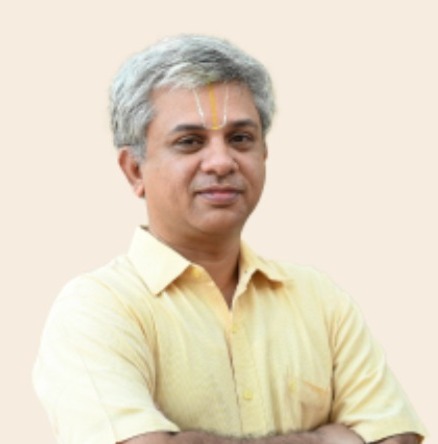
Professor,
Department of Mechanical Engineering, Wadhwani School of AI ,
IIT Madras
Balaji Srinivasan is a Professor at the Wadhwani School of AI and Dept. of Mechanical Engineering at IIT-Madras. He has a PhD from Stanford (2005), MS from Purdue, B.Tech from IITM. His current research interests are in Scientific Machine Learning, Numerical solution of PDEs and Applied Deep Learning.
Ganapathy Krishnamurthi is a Professor at the Wadhwani School of AI. He has a PhD from Purdue University (2008), MSc (Physics) from IITM. His current research interests are in Generative AI, and Deep learning applied to Medical Image Analysis and Medical Image Reconstruction.
Please use only the above methods for program queries.
Response time: 3 working days. During peak periods, Google
Meet links will be shared. Call wait times may be longer.